Claudine’s Tai Chi Services
Gentle movement for balance, breath and flow.
Explore Tai Chi as a calm, adaptable practice that can be approached standing, chair-supported or seated, with an emphasis on controlled movement, steady breathing and mindful attention.
Move at a comfortable pace and use a stable chair whenever support is helpful.

About the practice
A steady, approachable way to move with intention.
Claudine’s Tai Chi Services is centered on gentle movement that can be adapted to different comfort and mobility levels.
Tai Chi connects posture, breathing, balance and coordinated motion. The goal is not speed. The goal is to move with control, remain aware of the body, and build a practice that feels sustainable.
Claudine Young is the business owner. This page focuses on practical ways to begin, including chair-supported movement, a complete chair routine, a progressive 30-day activity plan, mindful breathing and everyday practice guidance.
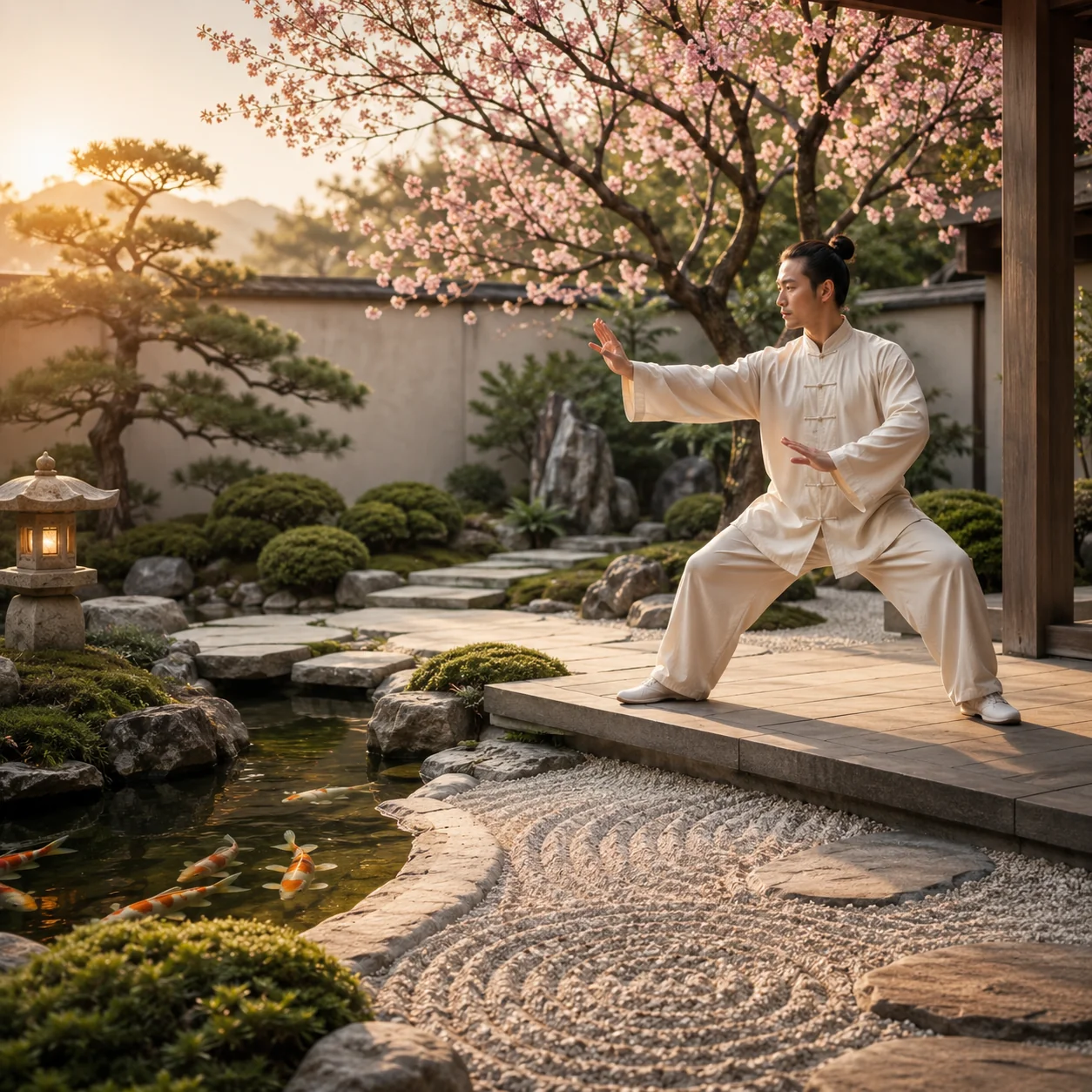
Services
Choose a practice path that meets you where you are.
The site is organized around three practical ways to use Tai Chi: seated or chair-supported movement, gentle standing practice, and structured home-practice guidance.
Chair Tai Chi
Use a stable chair to support seated movement, controlled leg work, torso rotation, arm flow and supported balance practice.
Standing & Balance
Practice slow weight shifts, upright posture, relaxed arm patterns and balance work while keeping a chair nearby when extra support is useful.
Home Practice Guidance
Follow the numbered chair routine and the 30-day progression on this page so the visual charts and written instructions stay together.
Programs
Three simple ways to build consistency.
You do not need to learn everything at once. Begin with a short routine, repeat it until the movements feel familiar, then increase duration gradually.
The Tai Chi Experience
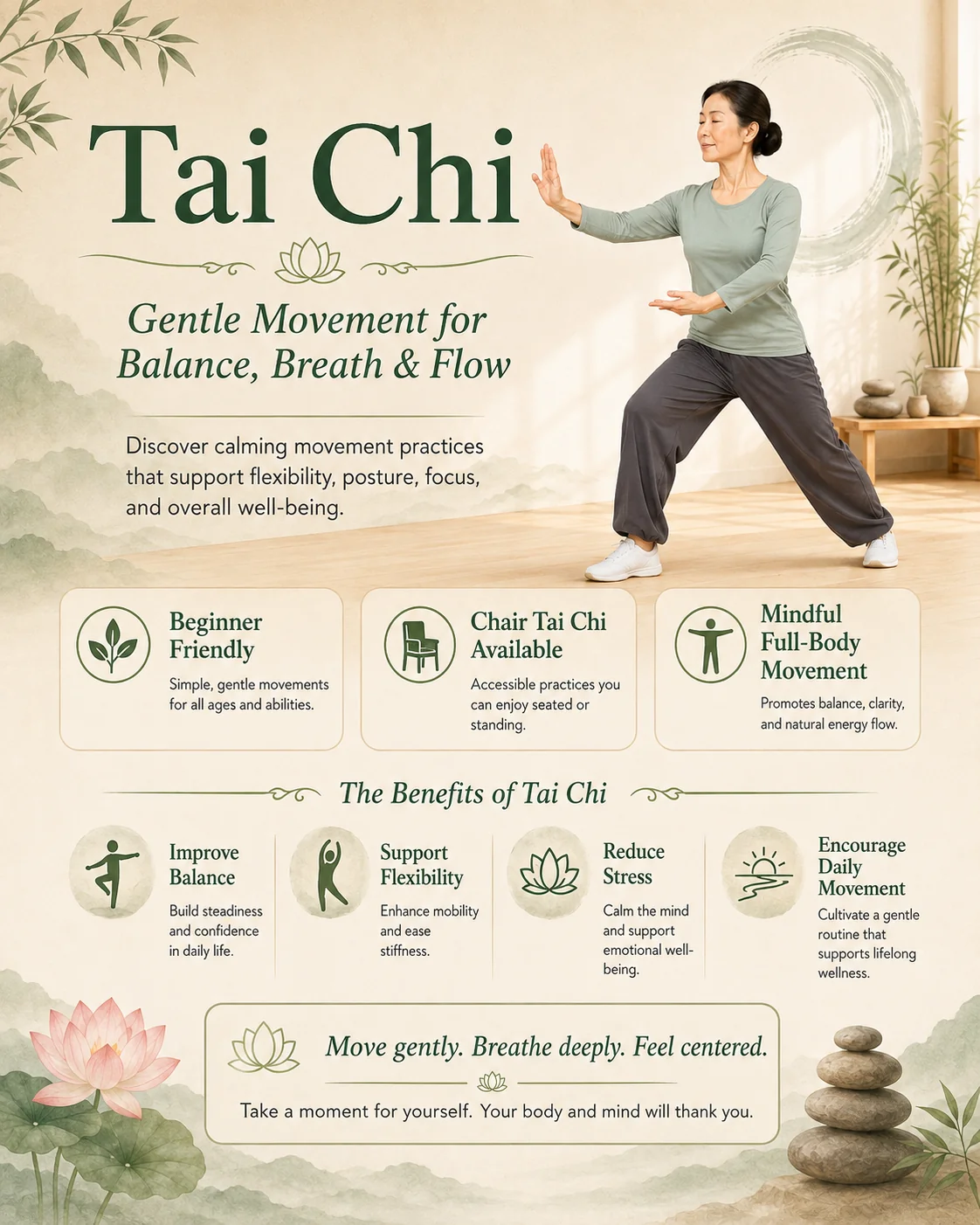
A calm visual reminder to slow down, breathe, and move with intention.
Use this image as a pause between the program overview and the practical routines below—a visual bridge from learning about Tai Chi to actually practicing it.
Benefits
Why people use Tai Chi as a regular movement practice.
Tai Chi is commonly used to support controlled movement, balance, flexibility, body awareness and a calmer pace of activity.
Chair Routine
Complete Chair Tai Chi Routine
The chart and the instructions below are one routine. Keep them together: use the chart to recognize each movement, then use the matching numbered text to guide the pace, breathing and repetitions.
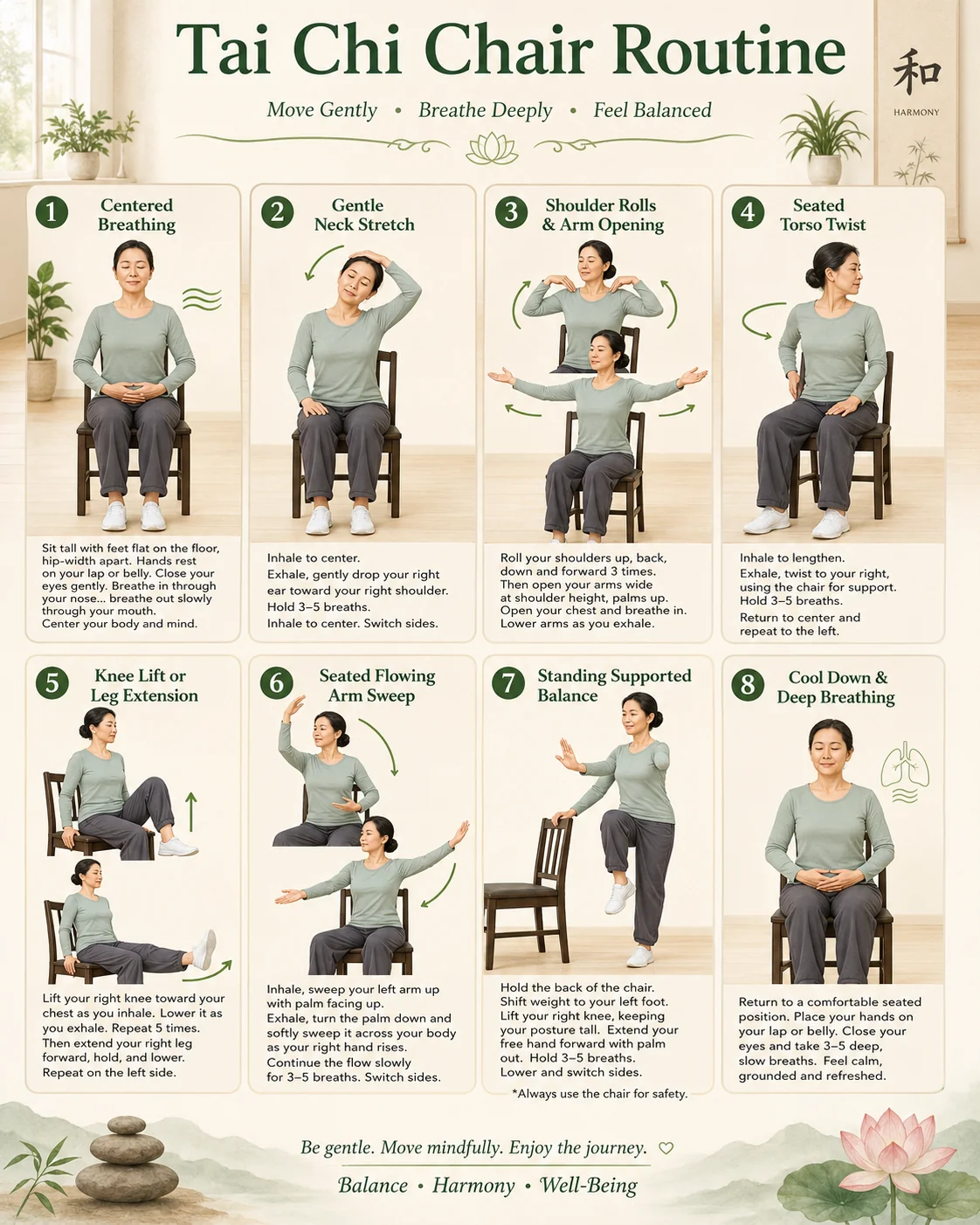
Visual chart: match numbers 1 through 8 to the written instructions beside and below it.
Use the picture for position. Use the written steps for execution.
- Place the chair on a firm, level surface before beginning.
- Work through steps 1–8 in order the first few times.
- Move slowly enough to keep breathing comfortable and posture controlled.
- For the standing balance step, keep a hand on the chair and remain seated instead if standing does not feel safe.
- Finish with the cool-down even when you shorten the routine.
Centered Breathing
Sit tall with both feet flat on the floor, about hip-width apart. Rest your hands on your lap or belly. Breathe in gently through your nose and breathe out slowly. Use several comfortable breaths to settle your posture and attention.
Gentle Neck Stretch
Inhale to center. As you exhale, gently bring your right ear toward your right shoulder without forcing the stretch. Hold for 3–5 comfortable breaths, return to center, then switch sides.
Shoulder Rolls & Arm Opening
Roll your shoulders up, back, down and forward about three times. Then open both arms at shoulder height with the palms turned comfortably upward. Breathe in as the chest opens and lower the arms as you breathe out.
Seated Torso Twist
Inhale to lengthen your spine. Exhale and rotate gently to the right, using the chair for light support. Hold for 3–5 breaths, return to center, then repeat to the left without forcing the range.
Knee Lift or Leg Extension
Lift the right knee toward the chest as you inhale, then lower it as you exhale. Repeat up to five times. Next, extend the lower leg forward, pause comfortably and lower it. Repeat on the left side.
Seated Flowing Arm Sweep
Inhale and sweep one arm upward with the palm facing up. Exhale, turn the palm down and let the arm travel softly across the body as the opposite hand rises. Continue the flowing exchange for 3–5 breaths, then switch emphasis.
Standing Supported Balance
Hold the chair securely. Shift weight onto the left foot, lift the right knee only as high as feels steady, keep the torso tall and extend the free hand forward. Hold for 3–5 breaths, lower with control and switch sides. Remain seated if standing is not appropriate.
Cool Down & Deep Breathing
Return to a comfortable seated position. Rest your hands on your lap or belly, soften your shoulders and take 3–5 slow, comfortable breaths. Let the pace settle before standing up or moving on with your day.
30-Day Plan
30-Day Chair Tai Chi Weight-Management Support Plan
This plan gradually increases session length and adds short, more active chair-based intervals. It is an activity progression, not a promise of a specific amount of weight loss.
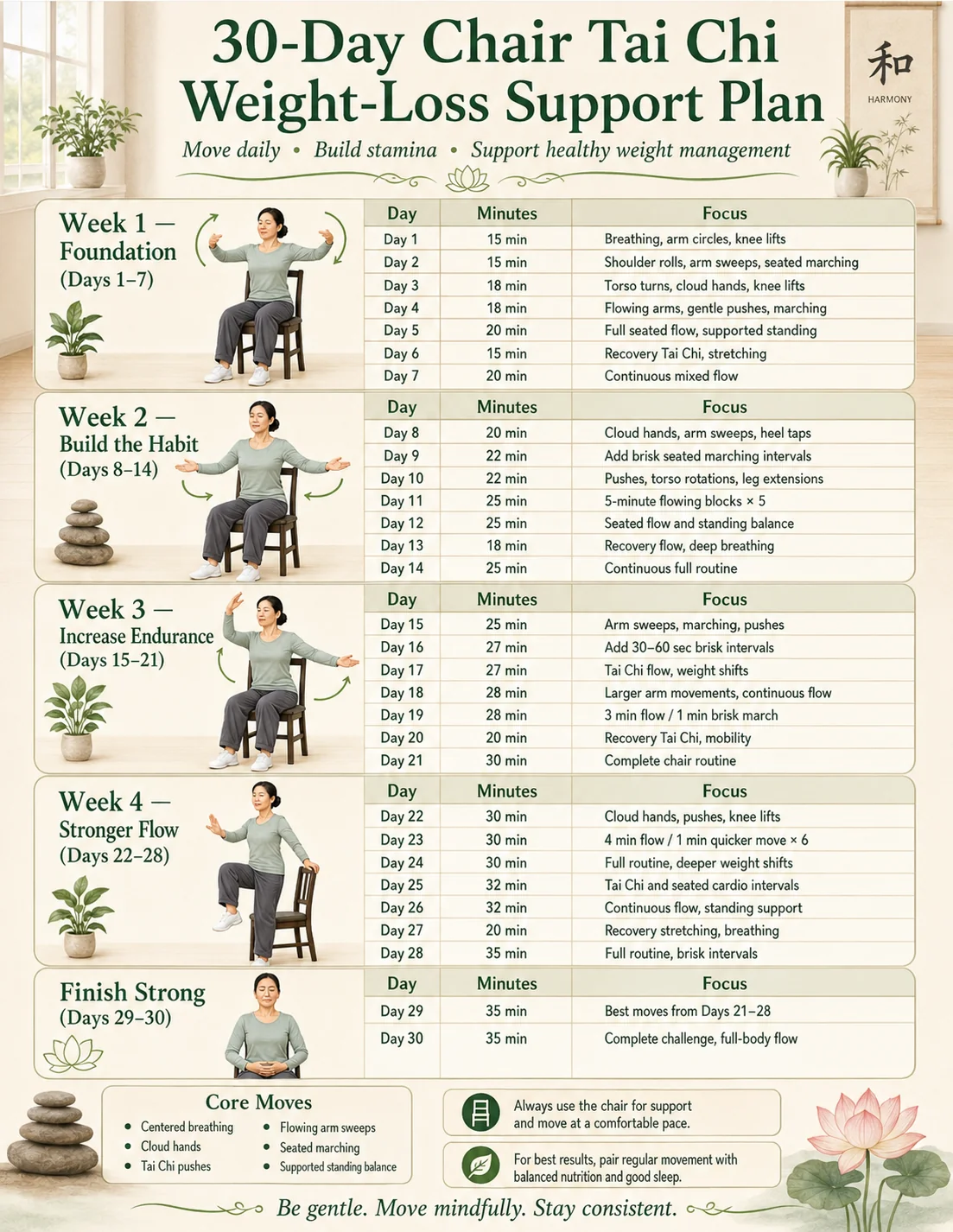
Visual chart: use it as the quick daily reference. The complete day-by-day schedule is directly below.
Find your day, complete the listed time, and follow that day’s focus.
- Days 1–7 teach the basic movement pattern and establish consistency.
- Days 8–14 build the habit by adding time and short marching intervals.
- Days 15–21 increase endurance with longer flowing sequences and weight shifts.
- Days 22–30 work toward approximately 30–35 minutes on the longer days.
- Recovery days are intentionally lighter; use them rather than trying to make every day hard.
All four chart columns remain visible on phones and wrap within the screen width.
| Day | Time | Focus | Effort |
|---|---|---|---|
| Week 1 — Foundation (Days 1–7) | |||
| Day 1 | 15 min | Breathing, arm circles, knee lifts | Easy |
| Day 2 | 15 min | Shoulder rolls, arm sweeps, seated marching | Easy |
| Day 3 | 18 min | Torso turns, cloud hands, knee lifts | Easy |
| Day 4 | 18 min | Flowing arms, gentle pushes, marching | Easy–moderate |
| Day 5 | 20 min | Full seated flow plus supported standing movement | Moderate |
| Day 6 | 15 min | Recovery Tai Chi and gentle stretching | Easy |
| Day 7 | 20 min | Continuous mixed flow using familiar movements | Moderate |
| Week 2 — Build the Habit (Days 8–14) | |||
| Day 8 | 20 min | Cloud hands, arm sweeps, knee lifts or heel taps, breathing | Moderate |
| Day 9 | 22 min | Add brisk seated marching intervals between Tai Chi movements | Moderate |
| Day 10 | 22 min | Tai Chi pushes, torso rotations, leg extensions, cloud hands | Moderate |
| Day 11 | 25 min | Five-minute flowing blocks, repeated five times | Moderate |
| Day 12 | 25 min | Alternate seated Tai Chi and supported standing balance | Moderate |
| Day 13 | 18 min | Recovery flow, mobility and deep breathing | Easy |
| Day 14 | 25 min | Continuous full routine with minimal resting | Moderate |
| Week 3 — Increase Endurance (Days 15–21) | |||
| Day 15 | 25 min | Arm sweeps, marching, cloud hands, knee lifts and pushes | Moderate |
| Day 16 | 27 min | Add 30–60 second brisk chair-marching intervals | Moderate |
| Day 17 | 27 min | Tai Chi flow plus supported standing weight shifts | Moderate |
| Day 18 | 28 min | Continuous seated flow with larger controlled arm movements | Moderate |
| Day 19 | 28 min | Alternate 3 minutes of Tai Chi with 1 minute of brisk seated marching | Moderate |
| Day 20 | 20 min | Recovery Tai Chi and mobility | Easy |
| Day 21 | 30 min | Complete chair Tai Chi routine | Moderate |
| Week 4 — Stronger Flow (Days 22–28) | |||
| Day 22 | 30 min | Cloud hands, pushes, knee lifts and marching | Moderate |
| Day 23 | 30 min | 4 minutes flowing Tai Chi / 1 minute quicker movement × 6 | Moderate |
| Day 24 | 30 min | Full routine with deeper, controlled weight shifts | Moderate |
| Day 25 | 32 min | Tai Chi with seated cardio intervals | Moderate |
| Day 26 | 32 min | Continuous flow with chair-supported standing portions | Moderate |
| Day 27 | 20 min | Recovery stretching, mobility and breathing | Easy |
| Day 28 | 35 min | Complete routine plus brisk seated intervals | Moderate |
| Finish Strong (Days 29–30) | |||
| Day 29 | 35 min | Repeat the strongest, most comfortable movements from Days 21–28 | Moderate |
| Day 30 | 35 min | Complete Chair Tai Chi Challenge — continuous full-body flow | Moderate |
Beginners
Start smaller than you think you need to.
A beginner-friendly practice is one you can repeat. Comfort, control and consistency matter more than large ranges of motion.
Mindfulness
Let the breath set the pace.
Tai Chi does not require complicated breath counting. The simplest approach is to keep breathing comfortable and let the movement stay slow enough that you do not feel rushed.
Practice Tips
Make the routine easier to keep doing.
A useful practice is predictable, comfortable and simple to restart after a missed day.
Practice at a repeatable time
Choose a part of the day that usually has fewer interruptions rather than waiting for the “perfect” time.
Keep the chart visible
Use the routine chart as the visual cue and the written steps as the detailed guide so you do not have to remember the sequence.
Use recovery days
Lighter days are part of the 30-day plan. They help preserve consistency without turning every session into a test.
Stay within a comfortable range
Movement does not need to be large to be useful. Reduce range or stay seated whenever that makes the practice steadier.
Pair movement with daily habits
Attach a short session to an existing routine, such as after morning coffee or before an evening wind-down.
Resume without “making up” days
If you miss a day, continue with the next appropriate session instead of doubling the time to compensate.
FAQ
Common questions about using the routines on this page.
Open any question below for a clear, practical answer. This section is designed to make the chair routine and 30-day plan easier to follow with confidence.